States and Provinces
Book / Produced by partner of TOW
Politicians in liberal democracies have rarely been held in lower public esteem than they are today. Governments seem remote, unresponsive, indifferent to our interests. It is understandable that in such circumstances people shut out politics and simply get on with their private lives. To do so, however, carries a serious risk, for governments will always have a major influence on our daily environment. We need to recover a sense of the high calling of government as one of the institutions established by God for human welfare. This happens on the level of the state or province.
What Is the State?
When we speak of the state, we refer to the whole system of the national government of a country. This includes the lawmaking body (such as the U.S. Congress); the executive body, which implements the law and determines national policy (such as the U.S. presidency); and the judiciary, which interprets and enforces the law (the U.S. Supreme Court, for example). In addition, federal states like the United States or Canada have two distinct territorial levels of government: the national or federal level and the state, provincial or regional level. The lower level has its own legislative, executive and judicial bodies, possesses powers to control certain areas of legislation and policy and plays a vitally important role. In this article state is explored both as a national system and as a territorial region within a national state.
The State as a National System
Why do we have states? The purpose of the political institutions we have come to call the state is to secure a just public order—something every society and every individual citizen needs. Scripture testifies to this purpose and attributes it to divine providence (Romans 13:1-2). The Bible lays down no constitutional blueprint, but it does consistently teach that the task of the state is to establish a just public order in society (Judges 2:16; 1 Peter 2:13-14).
Interpreting the contemporary meaning of this biblical injunction is unavoidably controversial, yet the following can be suggested as broad tasks of government today: protecting the liberty of individuals, families and associations; guaranteeing the provision of basic needs, especially those of the poor and vulnerable; preventing the undue domination of society by particular groups (such as corporations or unions); punishing public wrongdoing; safeguarding the quality of the environment and promoting just international relationships.
Territorial Regions in the State
Among the just relationships that it is the duty of the state to safeguard are those that between different territorial units within a country. In some countries these territorial units may have long-standing historical, cultural or ethnic roots that may merit special legal (even constitutional) protection (such as the Province of Quebec in Canada or the communities of native peoples in the U.S.A. and in Canada). Here the case for a federal division of powers is particularly strong.
Such a division also comports well with powerful Old Testament warnings against the centralization of political power in ancient Israel (compare Deut. 17:14-20; Numbers 2; Numbers 33:54-56; Joshua 13-19; Neh. 4:13). Indeed, the biblical material implies a general preference for federal-type or decentralized systems, even in medium-sized and smaller countries, in order to allow the people or their representatives to participate effectively in political decision-making.
A good place to begin the task of citizenship is to try to influence what goes on in the available closer units of political decision-making: a school board, a neighborhood, a city government, a state or provincial legislature. A national government characterized by justice depends upon citizens, individually or corporately, taking small steps of justice in the immediate spheres within which God has called them to serve.
» See also: Citizenship
» See also: Justice
» See also: Politics
» See also: Power
» See also: Principalities and Powers
References and Resources
P. Marshall, Thine Is the Kingdom: A Biblical Perspective on Government and Politics (Grand Rapids: Eerdmans, 1984); S. V. Monsma, Pursuing Justice in a Sinful World (Grand Rapids: Eerdmans, 1984).
—Jonathan Chaplin




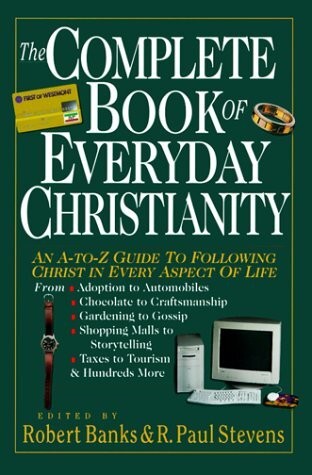
The authors Robert Banks and R. Paul Stevens have partnered with The Theology of Work Project to offer The Complete Book of Everyday Christianity in its entirety here. All rights reserved.
This resource was originally published in 1997, and the text has not been updated.